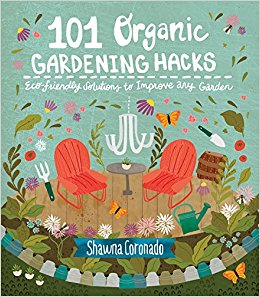
Shawna Coronado’s enthusiasm is contagious in her latest offering, 101 Organic Gardening Hacks: Eco-friendly Solutions to Improve Any Garden.
She’s going on a journey to reuse, reduce, and recycle in the garden in some wonderfully inventive and a few wacky ways, and she’s inviting you to come along. Overall, this 4-color 160-page guide is a very handy and appealing one for this spring. Every time I open it I get excited, and I learn a little something new.
A hack, notes the author, is just a great idea that’s come to life. It’s the short path to the desired result. Hacks in the book are organized by type (maintenance, edible, seedlings, tools) and they really are great ideas.
Here are a couple of my favs:
 Hack 43 – Pet tender seedlings to keep them strong and stocky (put thigmotropism to work for you). I’m all over this one and had forgotten that. Grateful for the reminder.
- Hack 61 – Regrow food from cut kitchen scraps is a great reason to enjoy leeks, celery, or herbs in spring. You can plant them in your garden after dinner! Step by step instructions for increasing your likelihood of them taking are included. I really haven’t done this successfully, but am grateful that a gardener more enthusiastic than I has. I’ll try it again!
There’s a secret about gardens – they don’t have to be hard. You can practically toss seeds at the ground in spring and they will pop up amongst the weeds (and will pop up even better if you take a little time to pull the weeds). But you can keep it very very easy and simple.
That’s why I love Shawna’s new book – it’s in that spirit of whatever you can do. It’s not fancy, not precious. It’s a get-out-there and put-your-hands-in-the-earth (which I swear is a nutrient – hands in earth nutrient) sort of attitude. It’s reuse that plastic container attitude. It’s begin where you are attitude. I love me an expert who has that type of DIY (do it yourself) attitude – not what I call a guru “only I know” attitude.
Happy digging, be it containers on your windowsill, a square in your back yard, or the whole wide world.
Would you like to connect with me in the tropics in February 2018? Check out my Pura Vida Retreat. It’s filling up, so if it sounds like your cup or tea, reach out!
Pinterest
As the end of summer rolls around, saving a few seeds connects you with the rhythms of nature and gives you an opportunity to know more than one generation of a plant. I loved my white cosmos this year, and they can be hard to find early in the season. So, I’ve been harvesting, drying and saving their seeds.
I use white cosmos as a 6th and 7th chakra plant – to help with deepening intuitive wisdom and divine connection. I make flower essences, and used their dried petals in flower baths.
(I had a video but removed it, hopefully just for a few moments…)
pinterest
Updated May 17, 2023
Rituals add meaning to life. Over the past several years I have been participating in plant initiation rituals. They connect me more deeply and more coherently with nature than I have ever been.
As I write this, the wheel of the year approaches the summer solstice. This day is truly filled with light. I am preparing for a shamanic plant initiation that will unfold next weekend, a gathering of plant people led by my teacher and St. John’s Wort.
What is Plant Initiation?
Plant spirit healing is a shamanic plant medicine practice that works energetically with and through plants for health and healing. In that tradition, a plant initiation is a coming together in a ritual to honor, connect deeply with, hear and receive the healing gift of a plant. It tends to involve experiencing the plant in a variety of ways; through breath, dieting (ingesting) wonderful things prepared by the facilitator. It is done in a ceremony; with singing, fires, shamanic guided imagery journeys and the like.
My Experience With Plant Initiations
I have undergone several plant initiations so far and treasure this ritual experience in my life. Perhaps it’s my Catholic upbringing, filled with ritual. I was initiated by Tulsi (the green goddess!) and left with a spirit soul sister, someone to go mystery-shopping within the cosmos. From Tulsi I learned ageless beauty and that all of the Shakti goddesses are within me – I can learn to draw upon them when needed. I was initiated by Dandelion (the indestructible grandfather guide!) at Damanhur, the eco-spirit community in Italy, and learned steadfast resiliency and impenetrability of spirit. Now it is St. John’s, and I already have a close relationship with the bestower-of-light. I hope to burn off a bit of dross and am open to an enlightening experience!
Bless you and may you have your own nature encounter today. Tell us about it!
Pinterest
Last year when I went to my plant spirit teacher’s retreat in Vermont, to the land of nature – outdoor showers, sleeping in bunks, and composting toilets, she asked us: How do you honor your indigenous self?
After a couple days of crud, I felt her – my indigenous self. As I got a little grody, I definitely got more ecstatic. It felt good to lie on the ground, wash in the stream and not worry so much about how I smelled. Something inside me became quite a bit happier than I usually am in my day-to-day connected life.
The more I’m outside the better I feel. But when I work (inside) a lot, I feel myself becoming outdoor averse – a little nature fear sets in – I get goo-averse. It’s not that I’m afraid of getting hurt outside, it’s more my aversion of being slightly uncomfortable. Then I think about bugs – then I think about Lyme’s (a real concern), and poison ivy (I am +++ allergic and have been hooked up to an IV for it). That is usually enough for me to excuse myself from what I love – to be close to, connected to, in and touching nature.
AHA! Classic resistance. There she is! Talk about our indigenous self! My negative fearful resistant brain, convincing me it’s too inconvenient and the benefit (happiness) is not worth the cost (bugs or…well, dirt…the whole outside is made of that!).
A wise friend told me that when working with these things – emotion, resistance, the following 3 step process can be helpful:
Feel it. Honor it. Release it.
I add step four: Repeat.
Feeling resistance, like fear of getting outside, could be a sign – I call them indicators – that it’s time for self-examination. Time to question and lean in, and in this case, get out(side). I know that if I feel the resistance and do it anyway, most often I will be glad I pressed through, worked through and did it.
Am I the only one who gets nature-averse while loving nature? What’s your experience?
We live in a culture dominated by our heads. That’s made our lives pretty stressful. It doesn’t need to be that way.
A number of writers and teachers are working with concepts of energy coherence. While the science is early and evolving, the concept and practice is profound and it resonates with students. I have learned about coming into syncronicity on an energetic level as a means of tapping into my own internal wisdom, and to connect deeply with plants and nature. It’s fun and it works.
Head thinking and heart thinking are different. The head is a master at figuring out the best way to get from point A to point B, of calculating linear questions But please don’t give the head a question that doesn’t have limits, like “what should I do with my life?” The head is all about safety and risk aversion. Rather, use your heart for those questions of whom to marry, how to follow your bliss, or to connect more deeply with people and things around you. Learning how to use and balance these 2 amazing organs in our bodies and lives is one of the primary practices of leading a skillful integrated life.
The folks at the Heart Math Institute have been working on the science of honoring our hearts as a primary organ of perception for decades. Our human bodies contain a powerful oscillator – an organ that creates electronic frequency or a wave. You guessed it, it’s our heart. When waves come into coherence, waves amplify each other. Guess which emotions tend to bring our hearts and therefore our human bodies into coherence with nature? You guessed it again – gratitude and appreciation. When we create coherence with nature, we can hear it, feel it, and experience it more deeply. To me it feels like experiencing nature from the inside. It feels like I am connecting with a tree the way I connect to my grandmother – like a friend from way back. It feels wonderful and as it turns out, is big medicine for my body.
And THAT’s how you connect with plants and nature. By learning how to communicate with you heart. THAT’s what I learned from my wise and gracious teacher Pam Montgomery, and that’s what we’ll be teaching you over the 4th of July weekend at Kripalu!
Time to sign up, lovelies. Enrich your life, feel your integral place in the amazing and gorgeous web of life. Good food, good people, good work. See you there.
Here’s another practice for Deepening your connection to Gaia (mama earth).
Enjoy the season!